Cultural Cocktail Hour
Review: Photography and the Black Arts Movement, 1955–1985 at the Getty Center
By
Leticia Marie Sanchez
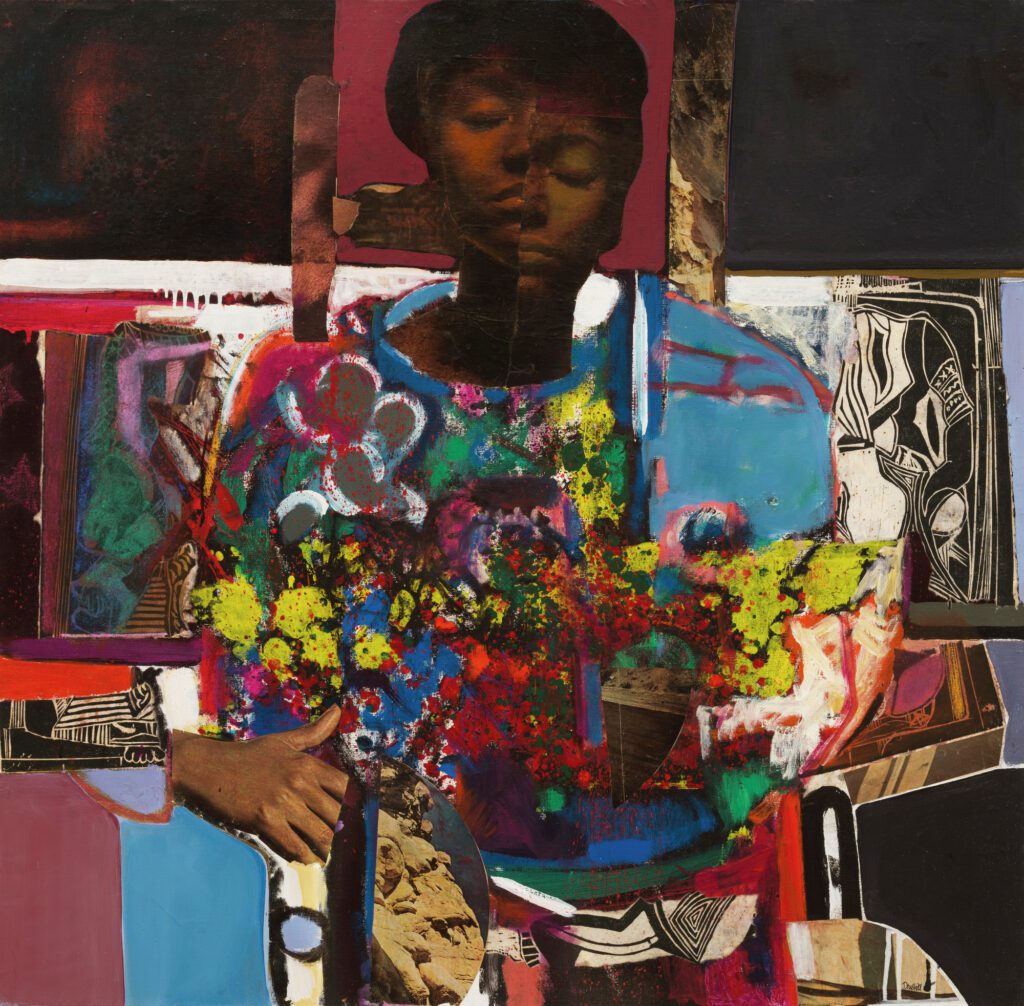
David Clyde Driskell (American, 1931–2020)
Set #4, Stephan W. Walls, 1978
From the series Faces
Oil and collage on canvas 37 1⁄2 x 38 1⁄2 inches
Art Bridges
© Estate of David C. Driskell, Courtesy of DC Moore Gallery, New York
EX.2026.2.6
*Digital reproductions limited to 1,000 px/96 ppi
The ancient Greek word root of the word “photography”means “writing with light.” True to its etymological origins, the new photography exhibit at the Getty Center sheds light on a critical moment in American history, bringing to light racial inequities through the lens of photography.
Curated with the National Gallery of Art in Washington DC, the exhibit showcases work from the mid-century to the 1980’s. According to Timothy Potts, the Director of the J. Paul Getty Museum, “Photography and the Black Arts Movement brings together works by more than one hundred photographers, painters, graphic designers, and multimedia artists who used photographic images in their struggles against inequality.”
One of the most moving pieces in the exhibit was by Darrel Ellis. Tragically, the artist’s father, Thomas Ellis, died due to police brutality in the South Bronx a few months before his son was born. Thomas was arrested over a parallel parking issue. Despite this minor offense, Thomas was cruelly thrown out of a police vehicle by intoxicated officers. This action caused Thomas to die from a fatal head injury. Ironically, before being killed, Thomas, a former Marine, had taken and passed an exam to become a member of the Police Academy. In an uncanny sequence of events, Thomas’ family received his acceptance letter into the Police Academy after he had been murdered by police. Darrel immortalized the father he never met by creating new works of art from his father’s photographs. Before he was killed, Thomas took photographs of the working class Black community in New York. At the Getty exhibit, one can view Thomas’ 1947 photograph entitled “The Game,” which depicts children playing hopscotch. Darrel reimagines his father’s drawing in a new work of art entitled “Untitled (Children Playing Hopscotch)” created with ink, wash, and graphite on paper. Darrel’s playful interpretation, with its blurred lines, seems like it emerged from the pages of a coloring book, thereby imbuing the original photograph with the spirit of childlike freedom.
The Black Arts exhibition is a true cultural cocktail in the sense that it integrates the visual and performing arts. For instance, on display in the exhibit are musical albums by vocal artists including Nina Simone, Marvin Gaye, and Gilbert Scott-Heron.The musical motif continues through Raymond Saunders’ artwork entitled “Charlie Parker (formerly Bird)” which combines photography and abstract painting in an homage to jazz musician Charlie Parker. Three burning crosses, emblematic of the sinister group of the Ku Klux Klan are embedded in the painting, with the word “bird” representing the uplifting power of voices, music, and art, which soar above the insidious forces of racism.
Ultimately, the vibrant works in the thought-provoking exhibit are not simply a time capsule of American history; the works are also a present-day rallying cry, an unbreakable melody for change that continues to persevere in the face of injustice, a voice that speaks truth to power and does not give up hope.
Click on a Category Below To Read More